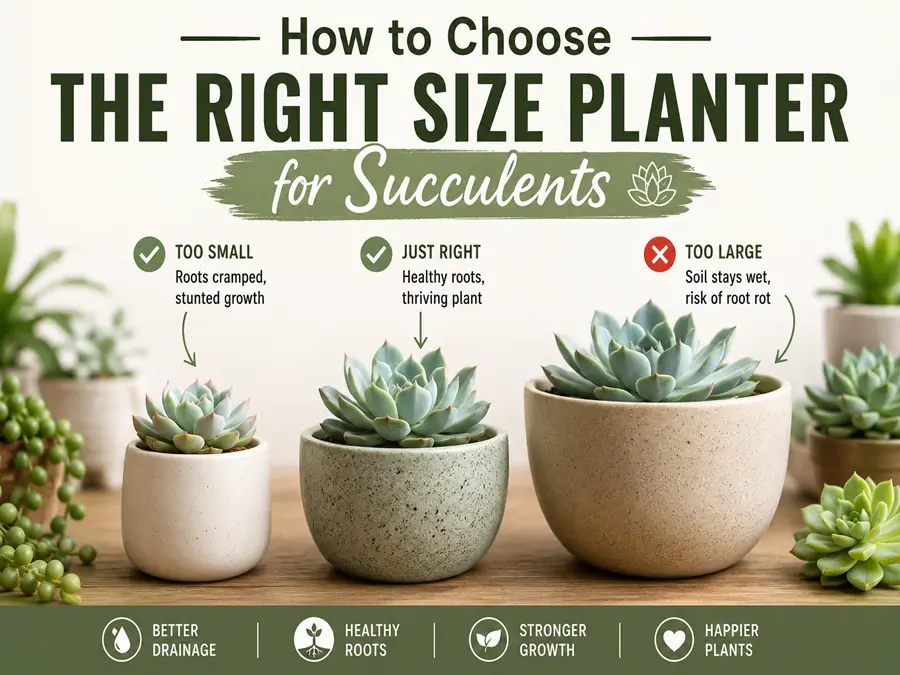
Choosing the right size planter for your succulents is one of the most important decisions you’ll make as a plant owner. While it’s tempting to choose a pot based on appearance alone, the size of the planter can have a major impact on your succulent’s health and growth.
Unlike many houseplants, succulents prefer conditions that allow their roots to dry out between waterings. A planter that is too large can hold excess moisture, while one that is too small may restrict healthy root growth. Finding the right balance helps prevent common problems like root rot and overwatering.
Why Planter Size Matters
Succulents are naturally adapted to survive in dry environments. Their roots are designed to absorb water quickly and then remain relatively dry for extended periods. Because of this, they don’t need a large amount of soil surrounding their roots.
The larger the planter, the more potting mix it contains. More soil means more moisture retention, which increases the amount of time it takes for the soil to dry completely. For succulents, constantly damp soil is often the fastest path to root rot.
Choosing an appropriately sized planter provides several benefits:
- Better moisture control
- Healthier root development
- Reduced risk of overwatering
- Improved drainage
- More attractive plant presentation
- Easier maintenance
A properly sized planter keeps your succulent comfortable and thriving for years.
How Much Bigger Should a Planter Be?
A good rule of thumb is to choose a planter that is only slightly larger than the root ball of your succulent.
For most succulents, the planter should be approximately one-half inch to one inch wider than the plant itself. Succulents generally prefer snug growing conditions rather than oversized containers.
For example:
- A 2-inch succulent works well in a 2.5 to 3-inch planter.
- A 4-inch succulent typically fits nicely in a 5-inch planter.
- A larger 6-inch succulent may prefer a 7-inch planter.
There’s rarely a need to place a small succulent into a large decorative pot. While it may look attractive initially, the excess soil can create watering issues that make it difficult for the plant to thrive.
Avoid Planters That Are Too Large
Many beginner succulent owners make the mistake of purchasing oversized planters. It may seem like giving your plant extra room to grow is a good idea, but succulents don’t behave like fast-growing tropical houseplants.
When planted in an oversized container, several problems can occur:
- Soil remains wet longer.
- Roots become susceptible to rot.
- The plant may focus on root growth instead of producing new leaves or offsets.
- Watering becomes more difficult to manage.
A succulent sitting in a planter that’s two or three times larger than necessary often struggles simply because the soil isn’t drying at the proper rate.
If you’re unsure between two sizes, it’s usually safer to choose the smaller planter.
Can a Planter Be Too Small?
Yes. While succulents enjoy snug containers, they still need enough space for their root systems to remain healthy.
Signs that a planter may be too small include:
- Roots growing through drainage holes
- Soil drying out extremely quickly
- Slowed or stunted growth
- The plant becoming top-heavy and tipping over
- Roots circling tightly inside the pot
Fortunately, most succulents grow slowly and don’t require frequent repotting. Many varieties can remain in the same planter for several years before needing additional space.
Choosing the Right Depth
Planter depth is often overlooked when selecting containers for succulents.
Many succulent varieties have relatively shallow root systems. Because of this, deep planters aren’t always necessary. In fact, shallow planters can provide several advantages.
Shallow planters:
- Dry faster after watering
- Help prevent excess moisture buildup
- Create attractive succulent displays
- Work well for multiple small succulents
Deep planters may be appropriate for larger succulent varieties or those with more substantial root systems, but most common succulents are perfectly happy in containers that aren’t particularly deep.
For many small succulents, a planter that’s three to five inches deep is more than sufficient.
Single Succulent or Multiple Succulents?
The size requirements change slightly when planting multiple succulents together.
If you’re creating a succulent arrangement, you’ll want to provide enough room for each plant while still avoiding excessive amounts of soil.
Consider:
- The mature size of each succulent
- Spacing between plants
- Drainage requirements
- Future growth patterns
A shallow bowl planter is often ideal for succulent arrangements. These containers allow multiple plants to share space without trapping excess moisture deep within the planter.
When arranging several succulents together, it’s perfectly acceptable for them to grow closely together. Many beautiful succulent displays intentionally create a crowded appearance that mimics their natural growing habits.
Repotting Your Succulents
Succulents don’t need frequent repotting. In fact, they generally prefer stability and can remain in their containers much longer than other houseplants.
Some signs that it’s time to move your succulent into a slightly larger planter include:
- Roots extending from drainage holes
- Reduced growth despite proper care
- Soil drying out almost immediately after watering
- The plant becoming unstable or top-heavy
- Visible overcrowding
When repotting, avoid jumping several planter sizes at once. Moving from a 2-inch pot directly into an 8-inch planter can create unnecessary watering challenges.
Instead, increase the planter size gradually by about one inch at a time.
Don’t Forget Drainage
No discussion about planter size is complete without mentioning drainage.
Even the perfect-sized planter can create problems if excess water has nowhere to go. Drainage holes allow water to escape and help the soil dry properly between waterings.
If you choose a decorative planter without drainage holes, you’ll need to be especially careful when watering or consider using a nursery pot inside the decorative container.
Proper drainage and proper planter size work together to create the ideal environment for healthy succulents.
Final Thoughts
Choosing the right size planter for your succulents doesn’t have to be complicated. In most cases, slightly smaller is better than significantly larger. Succulents prefer containers that fit their root systems comfortably without surrounding them with excessive amounts of moisture-retaining soil.
When selecting a planter, consider the width, depth, drainage, and future growth of your succulent. A properly sized planter not only keeps your plant healthier but also makes caring for it much easier.
With the right planter, your succulents can thrive while adding beauty and personality to your home or garden for years to come.